
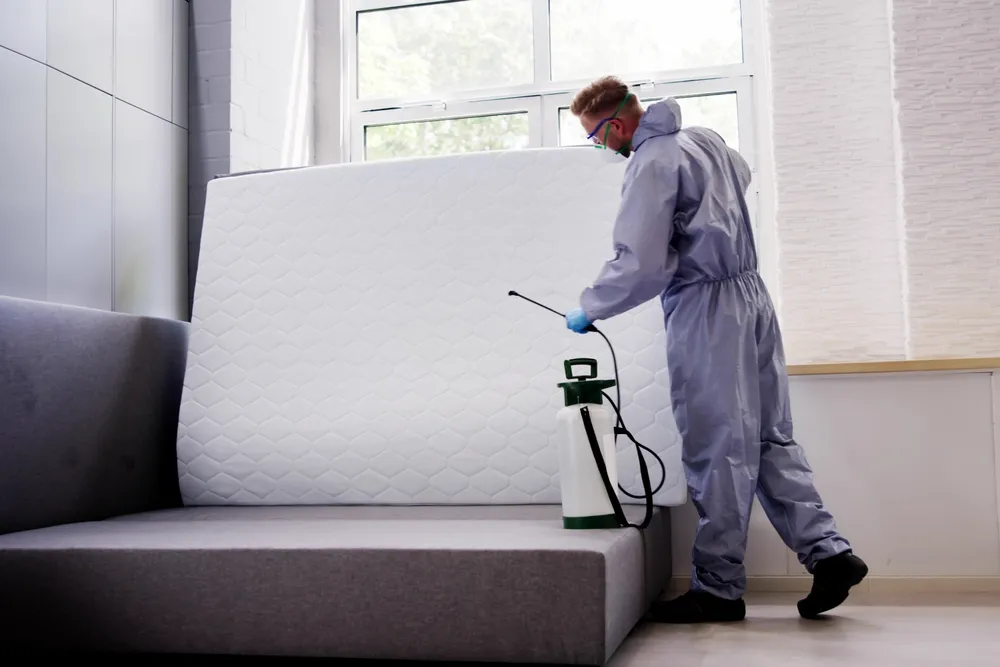
Bed bugs are among the hardest household pests to eliminate, and the reason is biology rather than cleanliness: they hide in seams and crevices, their eggs are unaffected by most sprays, and even spotless homes get them because they travel on luggage, second-hand furniture and public transport. Getting rid of them is entirely possible — but it takes the right sequence, and knowing where the DIY ceiling sits.
Confirming you actually have them
The signs are consistent: bites in lines or clusters, small dark spots on sheets and mattress seams, blood marks on bedding, pale shed skins, and in heavier infestations a musty odour. Check mattress seams, the bed frame’s joins, behind the bedhead, and the crevices of nearby furniture with a torch. Early confirmation matters enormously — a few insects are a manageable problem, an established infestation throughout a bedroom is a different job.
The home steps that genuinely help
Heat and cold are the honest DIY tools. Wash bedding, clothing and curtains at 60 degrees and dry on high heat. Steam-clean mattress seams, bed frames and carpet edges — steam kills on contact, including eggs. Items that cannot be washed can be sealed in a bag and frozen at minus 18 degrees for at least four days. Vacuum thoroughly with the crevice tool and dispose of the bag outside in a sealed bag immediately. Reduce clutter around the bed, and mattress and base encasements trap anything still inside where it cannot feed. All of this knocks the population down and protects you while the problem is being resolved.
Why DIY alone usually fails
Supermarket surface sprays rarely finish the job, for two reasons. Bed bug populations in Australia are widely resistant to the insecticides those products rely on, and sprays that repel rather than kill can scatter insects deeper into walls and adjoining rooms — turning one bedroom’s problem into a house’s. The eggs are the other half: anything that does not address the unhatched generation is buying two quiet weeks, not a solution.
What breaks the cycle
Professional bed bug treatment is staged for exactly that reason. Rapidkil’s bed bug program is a minimum of two treatments, two weeks apart, at $190 per treatment — the second visit lands after remaining eggs have hatched and before the new generation can breed, which is what actually ends an infestation rather than pausing it, and a particularly heavy infestation occasionally needs a third visit to finish. Preparation guidance comes with the booking so the home steps above and the treatment work together.
Keeping them out afterwards
Check mattress seams in any accommodation before settling in, keep luggage off beds and wash travel clothing on arrival home, and inspect second-hand furniture — particularly bed frames and upholstered pieces — before it comes inside. Bed bugs are hitchhikers; the habit of a thirty-second check is the cheapest treatment there is.
For treatment across Brisbane, Logan and Ipswich, call 0490 425 521 or request a quote online — licensed technicians, QBCC Licence 15104001.
